The same athlete, across the four distances
With your reference time scaled to each distance and the typical bike intensity of each, this is how the penalty grows as the day gets longer.
| Race | Typical intensity | Penalty | Seconds per km |
|---|
Home›Triathlon›Run off the bike
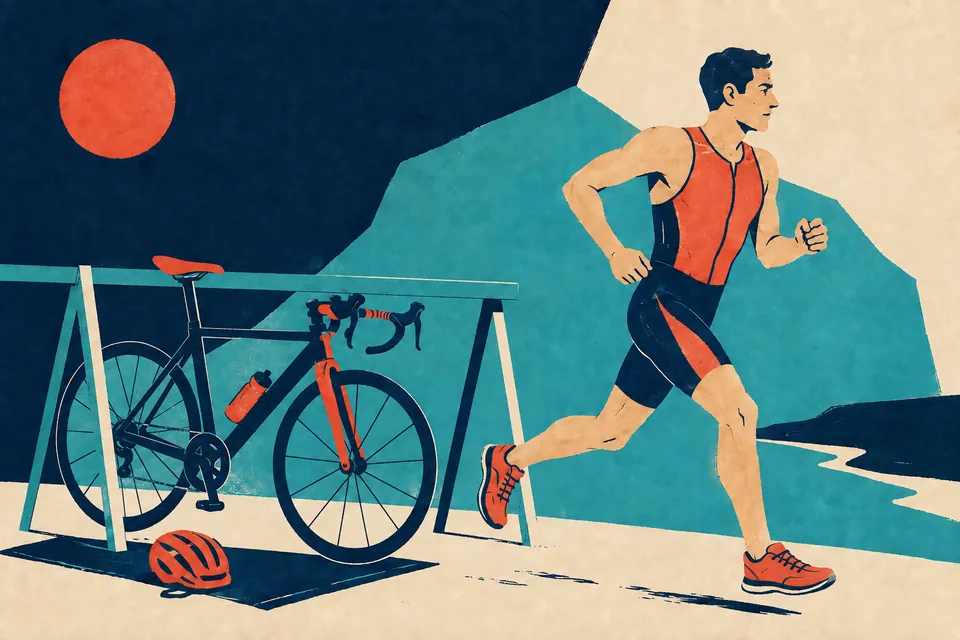
Nobody runs their fresh-legs pace in a triathlon. Enter your personal best over that distance and the intensity you plan to ride at, and this calculator tells you how many seconds per kilometre you will lose and what that adds up to.
| Intensity | Penalty | Pace | Run time |
|---|
With your reference time scaled to each distance and the typical bike intensity of each, this is how the penalty grows as the day gets longer.
| Race | Typical intensity | Penalty | Seconds per km |
|---|
The short answer: you arrive at the run with part of the tank empty and with legs doing a movement that is not theirs. The long answer has four pieces, and only one of them is fixed by training more.
Glycogen. You have been burning carbohydrate for one to five hours before taking your first step. In an Olympic distance race the impact is moderate; in an Ironman it is the dominant variable and explains why the marathon so reliably falls apart after kilometre 25.
The motor pattern. Pedalling is concentric, cyclic and impact-free, at 85 to 95 revolutions. Running is eccentric, with impact, at 170-180 steps. The first minutes are a change of program: the stride comes out short, the ankle stiff and the cadence low. That part does respond to training, and it is exactly what bricks address.
Blood distribution. After the bike, much of the flow is still in the pedalling muscles and in the skin shedding heat. Running efficiency drops while the body redistributes, which takes five to ten minutes.
Accumulated heat. You start running with an already elevated core temperature and the midday sun ahead of you. That is why the penalty rises so much in hot races, and why it should be built into your pacing plan.
The penalty is built on a base that depends on distance and is scaled by the intensity you rode at, your experience running off the bike and the heat:
The cubed exponent is what matters. Riding 10 % above the reference intensity does not worsen your run by 10 %: it worsens it by 33 %. That non-linearity is why the "ride hard and hang on" strategy almost never works, and why the five minutes you gain pedalling turn into fifteen lost running.
Three things work, in this order. First, ride easier: the biggest lever and the most uncomfortable to accept. Second, train the transition with regular bricks, even short ones: twenty minutes of running after a bike session does more than an isolated long run. Third, rehearse your fuelling on the bike, because whatever you fail to eat there you will miss at kilometre 30.
What does not work is trying to force the pace in the first kilometre. Your legs take five to ten minutes to become yours again: those who go out at target pace from the first step usually pay for it later.
Between 6 % and 12 % for most people, that is 15 to 35 seconds per kilometre. A 42-minute 10 km runner usually finishes between 45 and 47 minutes in an Olympic distance race, depending on how hard they rode.
Between 15 % and 30 %. A 3 h 30 min marathoner rarely goes under 4 h 05 min in an Ironman marathon, and if they overcooked the bike they can go beyond 4 h 30 min.
They are useful, but for less than people think. They improve the motor pattern and the head in the first kilometres, and that gain is real. They do not change the glycogen you have burned or the blood still in your quadriceps: against that, only riding easier and fuelling better works.
Because the stride carries over from pedalling: short, stiff and at low frequency. It usually lasts five to ten minutes. Deliberately raising your step cadence coming out of T2 shortens that period.
Far more than in a standalone run, because you arrive with an already elevated core temperature. Above 28 degrees the penalty can nearly double compared with a cool day, and in long distance racing it is the usual cause of DNFs.
Use the race time predictor, which calculates all three splits and the transitions with the same penalty model.
If this one was useful, these three will be too.
 Calculator
Estimate your finish time and every split for an Olympic, 70.3 or 140.6 triathlon from your swim CSS, your watts, the elevation and your run pace.
Open → Calculator
Tell me how long your session is, your carbs per hour target and what you carry — drink mix, gels, bananas — and get the plan minute by minute.
Open → Calculator
Work out your critical swim speed (CSS) from 200, 400 and 1000 m tests, your training zones, your per-100 paces and your open water time with a wetsuit.
Open →This calculator is an informational estimate and does not replace a coach or a laboratory test. Nothing you type ever leaves your browser.